Where Are the Nematodes? Soil Sampling to Facilitate Nematode Management Decisions
Knowing what nematode species are present in your potato fields — and at what population levels — is the foundation of effective nematode management. But getting accurate, actionable data starts with collecting the right sample in the right place at the right time.
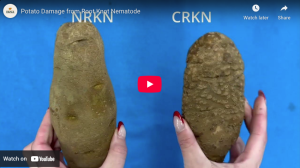
In this presentation, PAPAS researcher Hannah Baker explains the science of nematode soil sampling — including how many samples to collect, how deep to sample, and when to sample across the season. In this video:
- Why soil sampling is the critical first step in nematode management decision-making
- How sampling intensity affects your ability to detect low-, medium-, and high-density nematode species
- What PAPAS research is revealing about nematode depth distribution across Pacific Northwest potato fields — and why it matters
- How to develop a sampling strategy that fits your fields, your budget, and your management goals
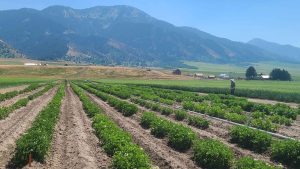
Hannah also shares early data from PAPAS field research at three Pacific Northwest sites — Hermiston, Oregon; Prosser, Washington; and Othello, Washington — examining how nematode populations vary by depth and season for Columbia root-knot nematode, root lesion nematode, and stubby root nematode.
Presented at the 2025 Washington & Oregon Potato Conference by Hannah Baker, former Research Technician at the USDA Agricultural Research Service (ARS) in Corvallis, Oregon.
PAPAS is a USDA-NIFA funded Scientific Coordinated Research Initiative (SCRI) working to develop science-backed tools, diagnostics, and management strategies for potato growers across the United States.
Explore our website for more information about potato nematode research and management. Find a nematode diagnostic laboratory with our online directory.