Q&A Panel: Management of Invasive Potato Nematodes
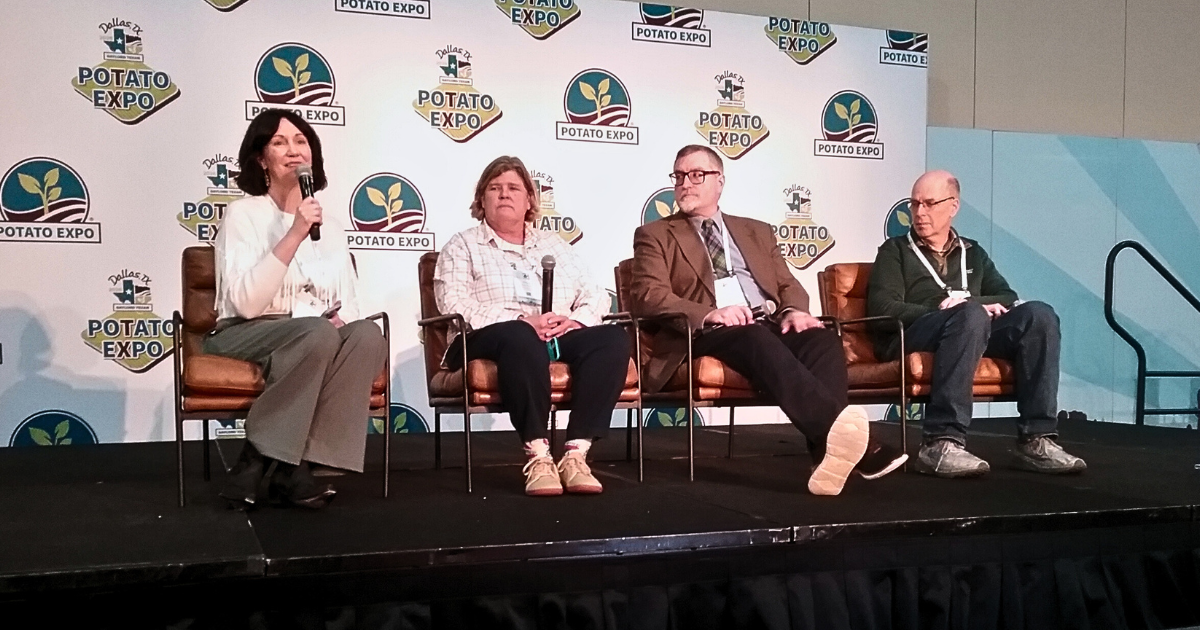
Presented as part of the Potato Talks series at the 2026 Potato Expo on Wednesday, January 7, 2026.
Most potato varieties grown in the United States are susceptible to potato nematodes. Recognition of the signs and symptoms of invasive nematodes such as root lesion, root knot and potato cyst are the first steps to preventing economic damage from these pests. Field sampling, understanding lab results and applying damage thresholds are all important to implementing successful management strategies that can prevent spread, reduce costs, and minimize their impact.
This panel discussion covers cornerstones of nematode management, presenting the latest information on economic thresholds, and providing an update on the development of nematode resistant potatoes.
The panel includes these PAPAS Project Co-Directors:
- Cynthia Gleason, Ph.D., Associate Professor, Department of Plant Pathology, Washington State University
- Panelists: Inga Zasada, Nematologist, Nema Solutions, LLC
- Phil Watson, Agricultural Economist, University of Idaho
- Walter DeJong, Potato Geneticist and Breeder, Cornell University
An interactive Q&A with the audience, the panel asks:
- Which nematodes impact potato production?
- Why bother trying to control for nematodes?
- What are ways you can manage potato nematodes?
- How much on average does nematode control cost a farmer?
- How much do nematode outbreaks cost the broader economy?
- For which potato nematodes are US/Canada breeders currently trying to develop resistant varieties?
- For which nematodes are resistant varieties available in the USA/Canada?
- Who benefits from potato nematode research?
Watch the video or read the transcript below.
Watch: Management of Invasive Potato Nematodes
Welcome everyone. Our next session here is the management of invasive potato nematodes. Our moderator is Cynthia Gleason. She has a PhD. She’s a professor in the department of plant pathology at Washington State University. We have Inga Zazada: has a PhD as a nematologist at NemaSolutions LLC. Phil Watson, PhD, agriculture economist from the University of Idaho. And we have Walter De Jong, PhD, potato geneticist and breeder from Cornell University. Can you help me to welcome them to the stage, please?
Okay, thank you so much and thank you for being here in the audience to learn about plant parasitic nematodeses. Um, today we’re going to be learning all about plant parasitic nematodes, about nematode damage, nematode resistance, and the economics of nematodes and potato production.
As you heard, for those of you who don’t know me, my name is Cynthia Gleason and I’m a nematologist at Washington State University and I study nematodes. I am also part of a larger project um called PAPAS.
Now PAPAS is a project that deals with plant parasitic nematodes. It stands for Potatoes and Pests: Actionable Science Against Nematodes. But PAPAS is also the Spanish word for potatoes. So I think it’s pretty appropriate that we call our project PAPAS.
Now um before I introduce the panel um I just want to also make this panel…it’s going to be an interactive session. Okay. And so part of that will be using app called Kahoot. So we’re going to start the Kahoot app and it’ll be really fun. So, basically once we bring up Kahoot, you’ll use your phone to scan the QR code, and then you will sign up for Kahoot, I hope. And it’s going to be sort of like a pop quiz for people in the audience.
And hopefully, you know, in this day and age when we have all this new technology, sometimes things don’t always work as you hope. But bear with us as we try to bring up the Kahoot. Oh, here we go. Okay. So, this will be really fun.
This is going to require active participation from you guys in the audience. We’re going to be asking a question and then you will have to answer on your phone. So, please take your phone out right now and scan that QR code. Okay. And then you’re going to sign up. You can work individually or as in teams.
Uh we’re going to ask some questions, questions about nematodes and nematode management and economics etc. And the question will appear on the screen and the answers will appear on your phone. And so you’re going to have to choose the right answer and you’ll then be ranked against each other, okay, based on whether or not you get the question right as well as how quickly you answer the question.
And I see people, you know, signing up as we speak. And as people sign up, I would like the panel to introduce themselves. Uh we’re all part of the PAPAS project. So, um I would like to have our panel tell us, you know, who they are and what they’re doing on PAPAS.
Great. My name is Inga Zasada. I’m based out of Corvallis, Oregon. Um, thank you. Um, I had most of my career with USDA. I just recently left the agency and started my own consulting and research business, NemaSolutions. And in the PAPAS project, I’m involved with objective one, which is decision support and trying to generate data to help you make better decisions about managing nematodes.
Hi, I’m Phil Watson. Uh, I’m an ag economist at the University of Idaho. Um my areas are on economic impact analysis and kind of the economics of different uh nematode mitigation strategies.
I’m Walter De Jong. I’m a potato breeder at Cornell University. I develop nematode resistant potato varieties.
Okay, that’s great. And I see that there’s a lot of people now signing up. Remember this is a competition. Uh you’re going to be competing against each other as we ask you questions. And the first question will be coming from Inga and she’s going to be asking about general nematode knowledge.
Okay. So, we’re going to make sure we’re all on the same page about nematodes. Um, so here comes the first question. Look at your phone. Okay.
Which nematodes impact potato production? You can select up to four. You have pin nematode, root lesion, root knot, stunt, cyst, stubby root. So you can select up to four.
Pressure’s on. There is a time limit. Oh yes, there is. No googling allowed. No what? No googling. No googling allowed. Okay, I think we’re ready to move on.
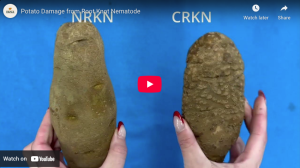
So, there’s four correct answers. Cyst nematodes, root lesion, root knot, and stubby root. And on the next slide, I just want to quickly summarize some of the impacts that they have on potato production. So that’s shown here. The top two are root knot nematodes. Temperant, what we call northern root knots (Meloidogyne chitwoodi), the Columbia root knot nematode, you’re probably very well aware of causes severe tuber damage. We also have the northern root knot nematode. Neither of them impact yield but impact quality. The root lesion nematodes (Pratylenchus penetrans and neglectus). If you’re from the Midwest, you’re certainly familiar with Early Potato Die, which this nematode contributes to.
Stubby root nematodes are all across the country. Probably the most important thing here is that they transmit tobacco rattle virus, which causes corky ring spot. And then finally, the cyst nematodes, very limited in distribution in the United States, thank goodness, widespread in Europe. Um, so we really want to keep these nematodes under check to protect potato production.
Great. Thank you, Inga. So, let’s move on to our next question. I can see the scoreboard quickly. Thanks.
Okay. Why should we even bother controlling nematodes? Uh, you have six different options. Nematodes can negatively affect quality. Nematodes can negatively affect yield. Nematodes can increase the cost of production. Shut down potato production. All of the above. None of the above. I already told you some of the answers on the last slide.
All right. All of the above. And again, just to give a little bit of context to this answer. Um, so reduce the quality of potatoes. Uh, reduce the price we see for potatoes. That would be quality impact by nematodes like Columbia root knot and stubby root. Reduce yields. That would be again be the root lesion nematode and potato early die. Increase the cost of production.
Phil’s going to talk about that and how much it costs to manage nematodes. And then finally, decrease the quality and increase the cost of potatoes to consumers is another reason we need to control them.
Okay, we’ll have one more question coming from Inga about general nematology. So get ready. Oh, Eskie is winning. Eskie out there, you’re winning so far. Now KJ is winning. Oh, it’s changing. Okay, the third question. Get ready.
All right. What are the ways you can manage potato nematodes? You can pick crop rotation, soil fumigation, cover crops, consult a psychic, all the above, none of the above.
I didn’t see the psychic booth here at Potato Expo, so. No, there’s not a psychic booth. Maybe next year.
All right. All of the above. And again, just some background on this. Um, you know, every management practice you choose has positives and negatives and I’ve tried to outline that in this slide. Um crop rotation oftentime you can get ride of a nematode once it’s in a field. So crop rotations often have to be very long. Fumigation very effective when done correctly, expensive. Phil’s going to talk about that.
And then cover crops. Nematodes tend to have wide host ranges. So sometimes you’ll plant a cover crop that will just make your problem worse. On the other hand, from a soil health perspective, it’s probably the right thing to do.
And then a psychic, I’ll let you decide what you want to do there by yourself.
Okay. Well, thank you, Inga. We’re going to move on now to uh Phil Watson, our economist, and he’s going to be giving us some questions about the economics of nematode and nematode management.
So, so far we have Jeffrey leading the scoreboard with Eskie right behind him. So, next question, please.
Okay, here we go into the economics. So, on average, how much on average does nematode control cost a farmer? So we have $100 per acre, $300 per acre, $400 per acre, or about $500 per acre, but up to $700. So what do you think on average across across the country?
And there we go. Yes, the correct answer is about $500 per acre, but it can be up to $700 per acre. And again, we have a little more uh context here.
So here here’s kind of some of the results of some of the studies we’ve done um looking at this across uh different place different parts of the US and there is some variation um in how much it costs to uh control for nematodes um but on average it’s about $500 and that boils down to about $400 in additional uh chemical costs and another $50 to $100 in costs that increase because of storage and and uh applications, things like that. So it’s a it’s a very significant cost to potato producers.
Okay, great. That’s very very interesting. Let’s move on to the next question again about nematode economics.
All right, this again we have Jeffrey in the lead. So Jeffrey, you’re doing great with Eskie right behind him.
Okay, so this question is more kind of in the broader economy. How much do nematode outbreaks cost in the broader economy? So, looking at all the economic impacts of potato uh nematode outbreaks. So, is it a $1,000 per 100 acres, $10,000 per 100 acres, $100,000 per 100 acres, a million dollars per 100 acres, or $10 million per 100 acres?
And the correct answer there is about $1 million per 100 acre of uh nematode. Basically, that’s taking it out of production with the nematodes. It’s huge costs.
And again, here’s kind of some of the breakdown across different uh parts, different states. Um but so these these numbers include not only the farmgate losses of potatoes but also again the the loss to uh the custom applicators.
You know when you take potatoes out of production it’s the whole supply chain that gets disrupted, including uh a loss of income to the farmers themselves and then that hurts all the way down to you know waiter waiters and waitresses at restaurants who are going to get less less income.
So when you put all those impacts together, that’s what we’re looking at here.
Okay. Thank you so much, Phil, for giving us some insights into the true cost of nematodes. It’s amazing how much nematodes are costing the economy.
And our—let’s see, we have Jeffrey. Jeffrey at the lead followed by Eskie. Now Spud King is up on the leaderboard as well in third place. So it’s been, you know, a good competition. But we’re not done yet.
We’re going to move on now to Walter. And Walter is a breeder and he’s going to tell us um some… he’s ask some questions about breeding.
So you’re going to see a list of six different nematodes that are known to cause damage in potato. The question is in an ideal world, breeders would be trying to develop resistance against all of them but it’s not an ideal world. Which three are we currently trying to breed resistance for?
So which three are we trying to develop resistance for is really a good question. I mean all these nematodes are so important but only a few are currently developing resistant varieties.
So the the correct answer is the golden cyst nematode, the pale cyst nematode and the columbia root knot.
And on on the next slide I guess after we see the scores a bit more. So we go to the slide with the with the answer.
So one of the things that’s unusual about this answer is that the golden and cyst nematodes are very localized in New York and and Idaho, the Columbia root knot on on the west coast. So although the root lesions is all across the country, there are no breeding programs currently trying to develop resistance to the root lesion neatodes. If that’s a nematode that really bothers you and think we should focus on, please talk to us or um let someone on the potatoes research advisory council know.
But for now, that’s that’s the state of the affair.
Okay, so the next question will be coming to you again from Walter. Oh, the scoreboard is important. Jeffrey is still in the lead, followed by Esie, so he’s doing really well. But the next question from Walter.
So of those three nematode species that we’re trying to develop resistant varieties against, for which ones do we actually have resistant varieties already? So that yeah you can see the six…with resistance.
Yeah it’s a really good question. I mean we all we want resistance to all these nematodes, but which ones do we currently have resistance?
Yeah. So the the correct answer is golden cyst nematode and pale cyst nematode. Um
and the and for for the golden nematode there are dozens of varieties that are resistant. So there’s no shortage of gold nematode resistant varieties in the US.
For pale cysts right now there’s a grand total of one and it wasn’t developed in North America on King Russer. It was bred in Europe and you could only get it I believe if you’re McCain’s grower.
For the other nematodes we don’t have resistant varieties yet.
Columbia root not I guess we hope to eventually because they’re trying and again for the other three no one’s even trying at the moment so if that’s something that interests you you should let us know.
Yeah, thank you, Walter. I think it’s really important to reiterate that we don’t have a lot of resistance yet in these commercially available cultivars in the United States, but there are active breeding programs, you know, for for many of them, and it’s it’s a long process.
Okay, so we have another question. Yeah.
Which of the following four options is the most difficult? Breeding the potato that’s resistant to a nematode, breeding the potato that someone wants to grow, matching four or five balls in the Powerball lottery, or sitting upstage here at the potato expo.
So the correct answer is breeding a potato that someone wants to grow. Breeding the potato that someone wants to grow is really hard. We we look at a 100 thousand or more individuals to find something that someone really wants to grow.
Um it turns out that breeding a potato that’s resistant to nematodes is actually kind of easy. But of course, no one wants to grow a potato just because it’s resistant to nematodes. It has to have everything else as well. That combination is the really challenging part. Creating a potato that someone wants to grow and is nematode resistant.
So if you’re asking a breeder to develop an nematode resistant potato, you’re asking them to do something on top of that which they’re already doing breeding potatoes someone wants them to grow. Um.
Yeah. No, that’s I think that’s, you know, fascinating. It’s more likely to win Powerball than to breed a potato that someone wants to grow. I mean, that just blows my mind.
Um okay, I think we have Okay, scoreboard. Eskie once again in the lead followed by Jeffrey and Spud King. Now we can’t forget that Mac and KD are also on the board.
Um I think we have one more question. The last question: Who benefits from potato nematode research? This is you know kind of a general question we’re throwing out there.
Yes, both potato producers and consumers.
And um before we kind of dig into that a little bit more, let’s look at our final scoreboard. Who’s on the podium? Spud King got third place. Spud King, are you out there? Spud King. Okay, Eskie, you got second place. Eskie. Yeah, great. And then our winner is Jeffrey. Okay. Jeff Miller. Yes. Little bit of a ringer there. That is amazing.
Okay. Well, thank you all for participating. But, you know, before we um end, we do want to talk about why potato nematode research is important and who benefits from this. Um I don’t know, Phil, if you wanted to, you know, take the lead.
Sure. Yea. Um so I think a lot of people maybe conventional wisdom is that this is mostly for producers, but I think ultimately um the the benefit of of this nematode research will end up in the end consumers with higher quality potatoes, um better access uh and and ultimately uh better prices they get for the potatoes.
So certainly it helps producers certainly, especially in the in the short run to bring their costs down of production and and reduce some of the risk of fail… you know crop failures. Um but then over time those benefits are transferred to consumers and in the lower prices and uh better quality and then ultimately there’s also a benefit to the environment where we have resistant uh varieties that will require less chemicals. So I think there’s winners across the board for this type of research.
Thank you, Phil. Yes, we all really benefit from potato nematode research and understanding the nematode, understanding potatoes and the interaction is key.
Um, so now what I would like to do is uh turn it back to the audience if there were uh information tidbits that we brought up that you have more questions. We’re here now for the next uh few minutes before we end our panel to answer your questions um and to get some feedback from you uh maybe about nematodes that you want to learn more about or think that maybe we should be focusing on.
The main focus of the PAPAS project right now is root knot and cyst nematode in potato. So yeah, we’re going to open it up to the floor for questions, comments, suggestions.
Any thoughts about potatoes, nematodes? I mean, I can um I can ask a question.
Um what do you think in terms of nematodes and potatoes is is like the future? What do you see as the future in terms of nematode control?
I guess the future for me it revolves around Telone and the cost and availability of Telone and the need for the industry and not only the potato industry but many high value crops to be able to navigate that space and I can’t say that we have you know we don’t have we don’t have silver bullets coming down the pipeline that that just doesn’t exist so I think from a PAPAS perspective it is developing a systems approach to nematode control that’s going to utilize a lot of different tools. Um, and I think with the stress in the market with Telone, this is going to happen sooner rather than later. We’ve been waiting decades for this to happen, but I do think it’s kind of happening in real time right now.
Hey, and Joe, I was going to say, can you go to the next slide? Oh, thank you.
All right. And that’s a good Thank you for reminding me, Inga. We wanted to thank you uh for your participation not only in the Kahoot quiz um but again if you have questions for us feel feel free to shout out. I also want to shout out PAPAS.
Um this is a multi-year large project of researchers from across the United States and we have a Facebook page, a LinkedIn page, YouTube videos… um you can sign up for email and check out our PAPAS page, as well we have a website um potatonematodes.org. A lot of information on that website. Um we have fact books, um information about uh sampling and even videos. So if you want to see some videos of people collecting nematodes and doing some extractions etc. please check out potatonematodes.org.
And so while you’re scanning those QR codes again, if there’s any questions from the audience, suggestions, comments…well then I’ll ask a question to our panel in the remaining couple of minutes.
Um so Walter, what is one of the biggest challenges aside from you know trying to get a um a potato that everyone wants, in terms of of finding resistance to plant parasitic nematodes and and why are you know you see stubby root and root lesion there’s no resistance out there. What is the challenge for that?
Typically the big challenge is finding a wild species that has resistance to the nematode you want. So someone has to go looking through the potato gene bank for example to find resistance to stubby root. I don’t know if central resistance exists. It’s not something I work with. But that’s typically a starting point is finding the resistance.
And then when you have a wild species, you have to make crosses. You’re talking about decades and decades of breeding that gene in and getting rid of all the other stuff in the wild species you don’t want. So it’s it’s a long-term prospect.
I guess I I’d like to add to the question you asked earlier to Inga: What do you see about the future of nematode control? I think in in the long term, of course, we’d like resistant varieties because you don’t need use the chemicals. It’s it’s sustainable. Um, one nice thing about resistance against nematodes is nematodes don’t have wings or legs. They can’t move long distances. So, resistance tends to be to hold up for a very long time in the field. Not not always. It depends on the nematode you’re dealing with, but it’s it it can be a more long-lasting control than than for a lot of other resistance genes against different pathogens.
And I guess following up on that, Walter, from start to… if you were to start a stubby root nematode resistance program, how many years till a variety might be available to the industry?
So if if if I was doing like if I was starting a program and I was not using genetic engineering just conventional crossing… 40 years. So it’s it’s it takes a long time when you start from a wild species. Just with conventional breeding already, if you make a cross today I’m releasing a variety 12 to 15 years from now. So that’s just without even the wild species component. It’s it’s slow. It’s slow but of course we all like it when we have the product that works. So
There’s a question there. Now we have some questions. Okay. Yeah.
Since Walter still has the microphone, uh do we have genetic markers for the resistance that we found in for pale cyst nematode and golden nematode?
Yes, there are there are markers for for both of those and and they’re used.
Uh are they just… are they stacked traits or is it just really the ‘we found the one single trait that’s necessary for resistance?’
So for golden nematode we largely rely on a single gene and it’s it’s been really effective for a long time. For the pale cyst nematode, no single gene provides exceptionally long durable resistance and we have to stack. So that’s an even harder thing to breed for than than golden nematode. Ideally we like as a breeder I prefer single gene resistance. It’s just so much easier to work with but obviously that’s not always possible.
Okay we have some other questions up here in the front.
Thank you. I’m from the Netherlands. We have a lot of problems with nematodes, but we are not allowed to fumigate anymore. Uh and I think you’re still allowed to fumigate in the US. So there is not so much pressure as we have in Europe for the breeding. So there’s a lot of work done and a lot of varieties resistant to to the golden nematode or to the pale nematode because we are under pressure from environmental. And the same with label light. So, but I don’t know if fumigation will one day be forbidden. If it is, you have a serious problem here also because of the rotation. Look, Prince Edward Island or Idaho or wherever one and two potatoes. Uh-uh. It’s not good. So, it’s more fumigation. Is that long-term possible or it’s not clear?
So, is fumigation long term? Yes, I think right now it is. We still have those products are registered. they’re they’re available. I think it’s the cost associated with them that’s going to be from come the cost and availability will become our first constraints.
Okay, we have time for one one or two more questions. Thank a
Are there any alternative strategies that any of you have worked with that are showing some promise i.e. biologicals [inaudible) any anything there?
Yeah. So, um, myself specifically, no, I certainly know that there are folks who work on this stuff that have, you know, decades long data sets that are I’ve seen one recently that this person has looked at compounds for a long time and seems to have a shortened list of things that, you know, have efficacy and that includes biologicals. The the future is biologicals. I mean, that’s what’s going to come down our pipeline and that’s what we’re going to have to get to work. I personally haven’t done that work, but there are folks that have.
Okay, we have time for maybe one last question if there’s any pressing questions. We’re all going to be here at the expo for the next few days. If there is.Oh, there’s a question. Okay.
Sorry for taking your mic. A quick question about breeding and LLMs. How much will large language models speed up the breeding process? This is outside my domain. Or will it not speed it up like AI?
Uh, it’s it’s not obvious to me that it will. No. The short answer is no. I think Yeah, it’s it’s I don’t think that’s the bottleneck. All right. Thanks.
Okay. I think we’re running out of time. So, I’d like to thank you all for your participation and for listening to us talk about nematodes. I hope that you were able to learn something about plant parasite nematodes and potatoes. So, thank you.