$500 Per Acre: The Real Costs of Potato Nematodes
By Philip Watson, Ph.D., Professor of Agricultural Economics, University of Idaho, PAPAS Project Co-Director
Potato production for the United States is estimated at 412 million cwt (or 41.2 billion pounds) with a farmgate value of $4.9 billion (USDA NASS, 2025). Because potato nematodes can cause significant economic losses for U.S. potato growers, our industry depends on effective management to maintain its global competitiveness and sustain farmer livelihoods.
The PAPAS project was created to minimize potato crop losses and protect grower profitability by supporting nematode management decisions with science-backed data and developing new, sustainable management solutions, including durable nematode-resistant potato varieties and new biological nematicides.
Economic activity in the potato industry will increase if our research is successful in resolving quarantines, reducing potato shipment rejections, and providing necessary strategies for effective nematode control. These efforts directly align with the USDA strategic goal to “maximize the ability of American agricultural producers to prosper by feeding and clothing the world.”
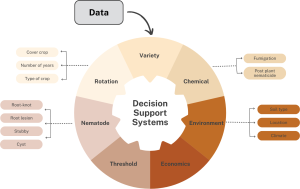
Potato growers rely on solid economic data when making nematode management decisions. Our team researches the financial impact of nematode management methods through predictive modeling and profitability estimates that reflect the majority of U.S. potato production systems.
Potato Production Costs
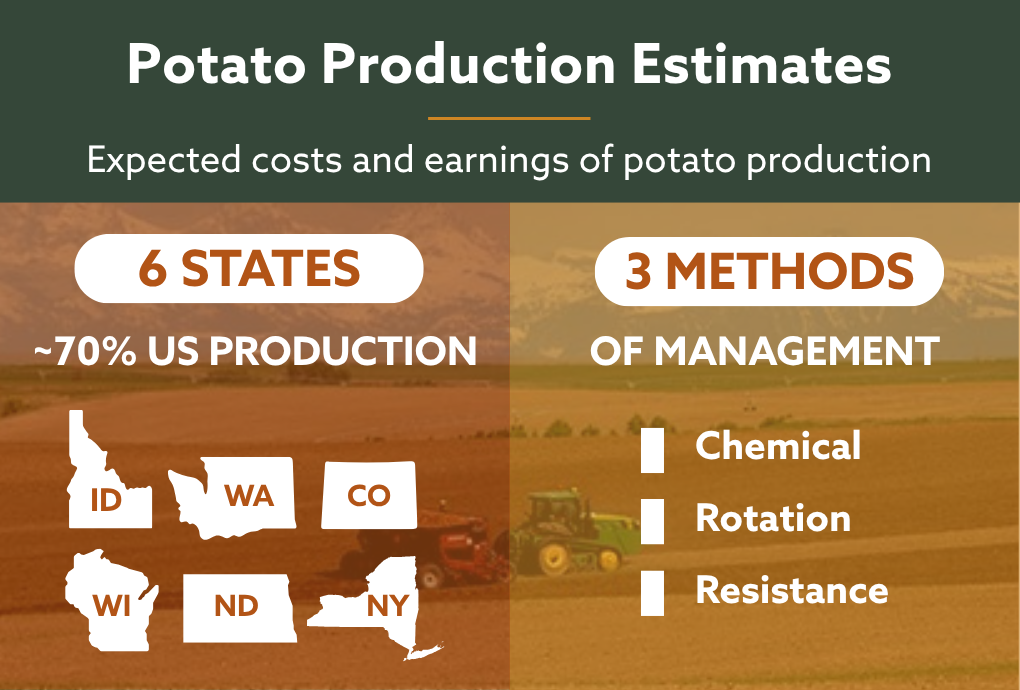
Using economic models, we generated standardized enterprise budgets for six states that represent more than 70% of total U.S. potato production (Idaho, Washington, Colorado, Wisconsin, North Dakota, New York).
These budgets track the expected costs and earnings of producing potatoes with three different nematode management methods: chemical, rotation, and resistant varieties.
Utilizing these state potato production enterprise budgets, we calculated the economic impacts of potato nematode outbreaks and their associated management costs. The results show significant losses to both farmers and the broader economy.
Potato Nematode Management Costs
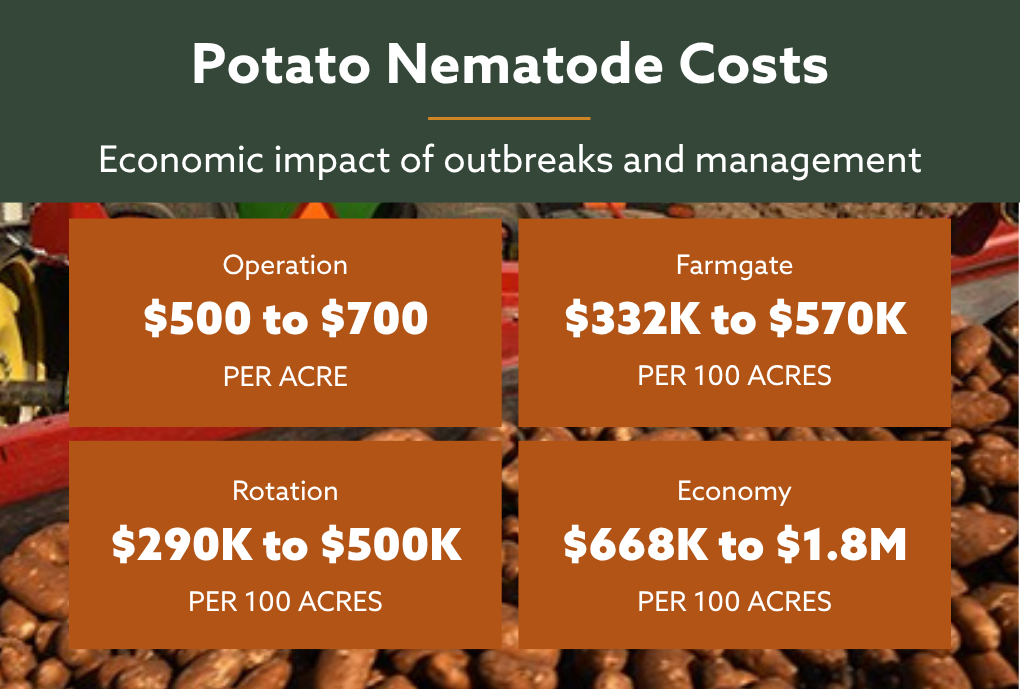
On average, nematode control costs a farmer in the U.S. about $500 per acre—but up to $700 per acre.
That breaks down to about $400 in additional chemical costs, and another $50 to $100 in increased harvest, storage, application, and operating costs.
Nematodes reduce farmgate revenues by $332,000 to $570,000 per 100 acres.
In several states, fumigation reduces the break-even price needed to cover total production costs, with yield gains that partially offset higher input expenditures. However, the margin remains thin in high-cost regions, underscoring the importance of site-specific decisions.
Net losses for rotational crops are between $290,000 and $500,000 per 100 acres.
When a nematode infestation forces acres out of potato production, growers can plant an alternative crop to partially offset the loss—but returns from a cereal or grain crop will always fall short of what potatoes would have generated.
Potato nematode outbreaks cost the broader economy between $668,000 and $1.8 million per 100 acres.
These numbers include not only direct farmgate losses in potato output, but also impacts throughout the supply chain and farm household income. When potatoes get taken out of production, the whole supply chain gets disrupted. That hurts all the way down to food service workers who make less income.
Nematode-Resistant Potato Varieties
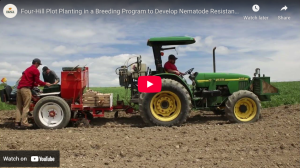
A significant effort of the PAPAS project is to accelerate the development of commercial potato varieties with nematode resistance.
No U.S. potato variety has meaningful resistance against pale cyst nematode or root-knot nematodes, and only two minor varieties have resistance against golden nematode pathotype Ro2. In contrast, dozens of U.S. varieties are resistant to golden nematode pathotype Ro1, which have been key to controlling the pest in New York for the past several decades.
While uncertainty remains about the costs and availability of new varieties, nematode-resistant potatoes make the most economic sense for potato growers by reducing pesticide costs and boosting yields. In the long run, these benefits also reach consumers with a larger, safer, and more affordable supply of high-quality potatoes.
Explore our website for the latest nematode management resources, economic decision tools, and research findings.