Build a Smarter Nematode Sampling Program for Better Management
By Inga Zasada, Ph.D., Nematologist, NemaSolutions, LLC, PAPAS Project Co-Director
Identification and management of plant-parasitic nematodes is a continuous challenge for potato growers. Although symptoms can vary, nematode damage in potatoes can look similar to nutrient deficiency or drought stress: stunted growth, reduced vigor, poor canopy development, and discoloration.
A well-executed soil sampling program bridges the gap between what growers can observe and what is actually happening in the soil, accomplishing three things that are foundational to any nematode management program:
- Specifying the nematode species present in a field.
- Measuring the population densities of those species.
- Interpreting the data to predict potential crop damage and guide management decisions.
With nematode sampling data, management decisions become more precise and cost-effective. That could mean modifying rotation decisions, choosing a different potato variety, planning a nematicide application or targeted fumigation, or determining that treatment isn’t justified at current nematode population levels.
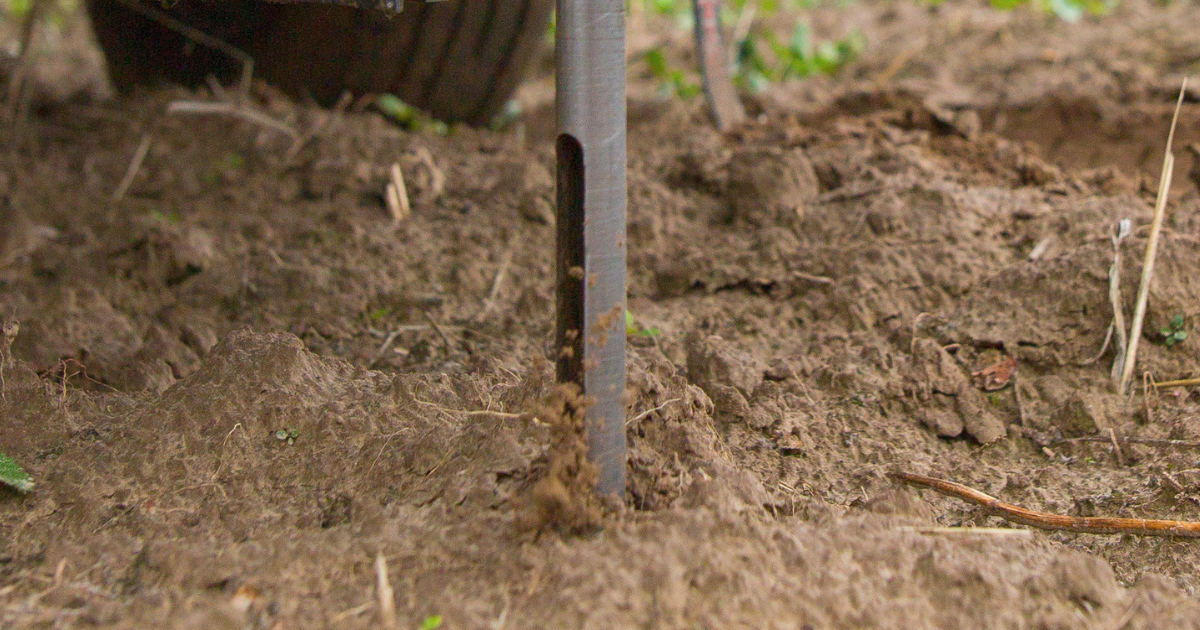
However, the quality of a nematode sampling program’s results depends on the quality of the samples collected. Soil sampling is not a one-size-fits-all practice. The right number, depth, and location of samples depends on the field, the target species, and the level of precision needed for management decisions.
As part of the PAPAS project, our researchers study the most problematic nematodes in U.S. potato production. By understanding how nematode population densities and dispersal patterns vary by species, we’re helping growers and their advisors build better sampling programs to manage these pests more effectively.
Number of Samples to Collect
When determining how many composite samples to collect per field, the general principle is straightforward: the greater the proportion of the field included in the sampling process, the more accurately the sample data reflects actual field conditions.
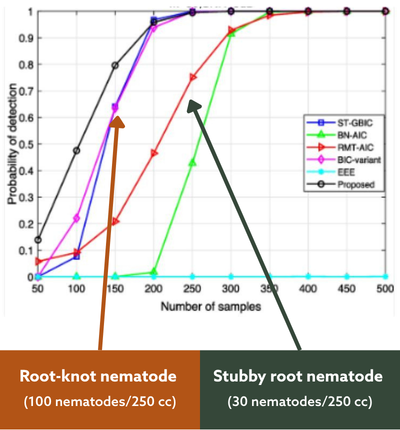
Growers know their fields better than anyone and that knowledge should inform sampling design. Factors to consider include field history, soil type, problem areas, and prior nematode detections.
Based on years of nematode research, the PAPAS team has developed three broad levels of sampling intensity for a standard 140-acre center pivot.
Low Intensity Sampling
Approximately 4 composite samples across the field — roughly one sample per 35 acres. Provides a general picture of nematode presence but has limited ability to detect low-density species or characterize the spatial distribution of populations across the field.
Medium Intensity Sampling
Approximately 8 composite samples — about one per 17.5 acres. Offers meaningfully better field coverage and improves detection probability, particularly for species present at moderate population densities. However, this also has limited ability to detect low-density species.
High Intensity Sampling
Seventy or more composite samples, down to one sample per acre. Establishes the most detailed and spatially precise picture of nematode distribution across a field, ideal for growers working with fields of unknown nematode history. Intensive sampling at the outset of working a field provides baseline information that can guide more efficient, targeted sampling in subsequent years.
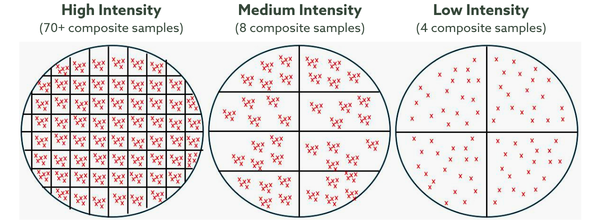
In addition to determining the right number of samples to collect, where to collect those samples is an important consideration of a well-designed program. If there is a specific species of nematode that growers are concerned about, that has a significant impact on the sample grid design.
Where to Collect Soil Samples
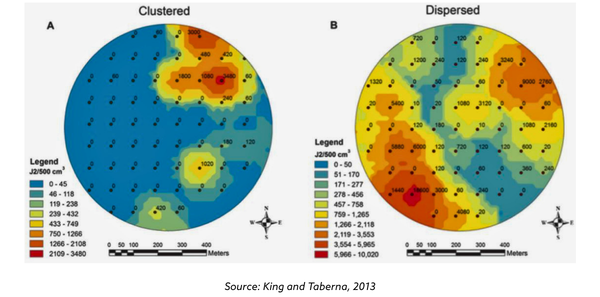
Not all nematodes behave the same in terms of density ranges or dispersal patterns. Understanding which species you are targeting and how it typically distributes itself should directly inform how you design your sampling grid and how you interpret your results.
Stubby Root Nematode (Paratrichodorus spp.)
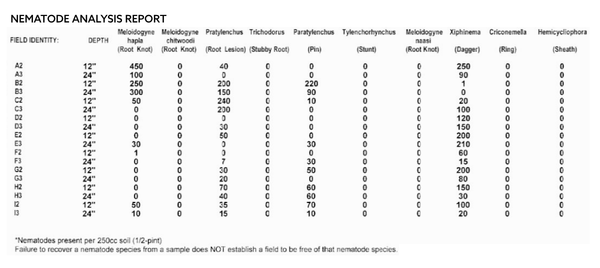
Stubby root nematodes are found at lower densities in the Pacific Northwest — approximately 30 nematodes per 250 cc of soil or less. Low populations can still cause damage. Distribution tends to occur in clusters or concentrated patches, making it hard to detect reliably with low intensity sampling. Infested fields may appear clean if samples are not collected in areas where populations are concentrated. High intensity sampling can help map areas of infestation for more targeted interventions, like precision fumigation, versus field-wide treatment.
Northern Root-Knot Nematode (Meloidogyne hapla)
The northern root-knot nematode occurs at medium densities, averaging around 75 nematodes per 250 cc of soil. It also occurs in more concentrated clusters rather than wide distribution across fields. Detection probability improves at medium sampling intensity, but intensive sampling remains the most reliable approach when this species is a concern.
Columbia Root-Knot Nematode (Meloidogyne chitwoodi)
The Columbia root-knot nematode can occur at high densities — exceeding 100 nematodes per 250 cc of soil — with patchy distribution across fields. Even low population levels cause severe tuber quality damage, including internal and external blemishing that can lead to market rejection. Knowing precisely where it is in a field, not just whether it is present, has significant management value and makes high-intensity sampling worthwhile.
Lesion Nematode (Pratylenchus spp.)
Lesion nematodes occur at higher densities — approximately 150 nematodes per 250 cc of soil. This nematode tends to be more dispersed across a field and will likely be detected with low intensity sampling due to its higher population densities, while medium intensity sampling will provide more precise data about where it is located.
While potato cyst nematodes (Globodera spp.) are included in this work, their management is subject to strict federal and state quarantine programs currently active in New York and Idaho, where these pests are present.
Sampling Depth Research
While horizontal movement of nematodes has been studied more extensively, less is known about their vertical movement at different points in the growing season and at what depths they are most active.
PAPAS researchers are addressing this gap through a multi-season field study at three Pacific Northwest sites (Hermiston, OR; Prosser, WA; and Othello, WA), collecting soil cores to a depth of three feet in spring, summer, fall, and winter, and processing samples at one-, two-, and three-foot increments to characterize vertical population distribution.
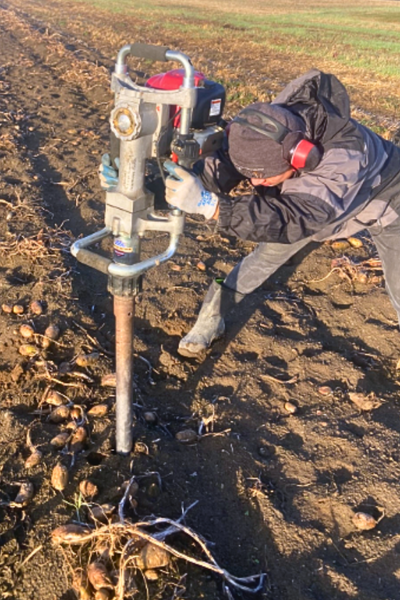
This ongoing research shows that nematode depth distribution varies by species — some nematode populations are active as deep as three feet in the soil profile — and that population peaks differ by species, season, and location. Limiting sampling to the surface foot of soil or certain times of year may mean missing out on meaningful nematode activity.
When to Collect Soil Samples
Nematode soil samples can be collected pre-plant, during the growing season, or post-harvest. Each window offers advantages depending on the species of concern.
- Pre-plant sampling is helpful for species that maintain higher population densities earlier in the season. Stubby root nematodes, for example, have shown higher spring populations at some Pacific Northwest research sites.
- Post-harvest sampling is a common and allows for making decisions on fumigation. For species that reproduce actively during the growing season, like Columbia root-knot nematode, sampling at this time captures populations at or near their seasonal high.
Results from both pre-plant and post-harvest sampling inform immediate and long-term management decisions. Combining data from both windows provides insight into how populations change in a growing season and how successful management efforts are.
Because seasonal population dynamics vary by species, location, and soil conditions, the optimal sampling timing for a given field depends on the nematode species of greatest concern. Working with a nematologist or diagnostician to determine the best sampling window for your specific situation is always recommended.
Building a Sampling Program
Potato growers working with fields of unknown nematode history are encouraged to begin with intensive sampling to establish a detailed baseline picture of the nematodes present and their spatial distribution. This upfront investment in data pays dividends over subsequent seasons by identifying problem areas that warrant continued intensive monitoring and intervention.
For fields with established sampling history, a tiered approach — intensive sampling in known problem areas combined with standard sampling across the broader field — provides ongoing monitoring without requiring the cost of intensive whole-field sampling every year.
In all cases, the most effective sampling strategy is one designed in collaboration with a nematologist or diagnostician who can account for field-specific factors: soil type, cropping history, irrigation system, and the species of concern. Growers can connect with a nematode diagnostic laboratory through our free directory: PotatoNematodes.org/Diagnostic-Labs.

Sampling done well, at the right intensity and the right time, gives growers the data they need to protect their crops, optimize their inputs, and make management decisions that are both economically defensible and scientifically sound.
PAPAS is continuing to develop and refine nematode sampling protocols, detection thresholds, and depth distribution models that give growers and their advisors increasingly precise guidance on how to sample smarter and manage better.
Explore additional resources to build more effective nematode sampling programs: