PAPAS Delivers New Tool for Potato Cyst Nematode Identification
Quick, reliable test differentiates key PCN species with simple equipment
A recently published article from PAPAS researchers Chandni Shah, Ph.D., and Louise-Marie Dandurand, Ph.D., summarizes their work in developing a faster, more reliable method of differentiating potato cyst nematode species — in the lab or in the field.
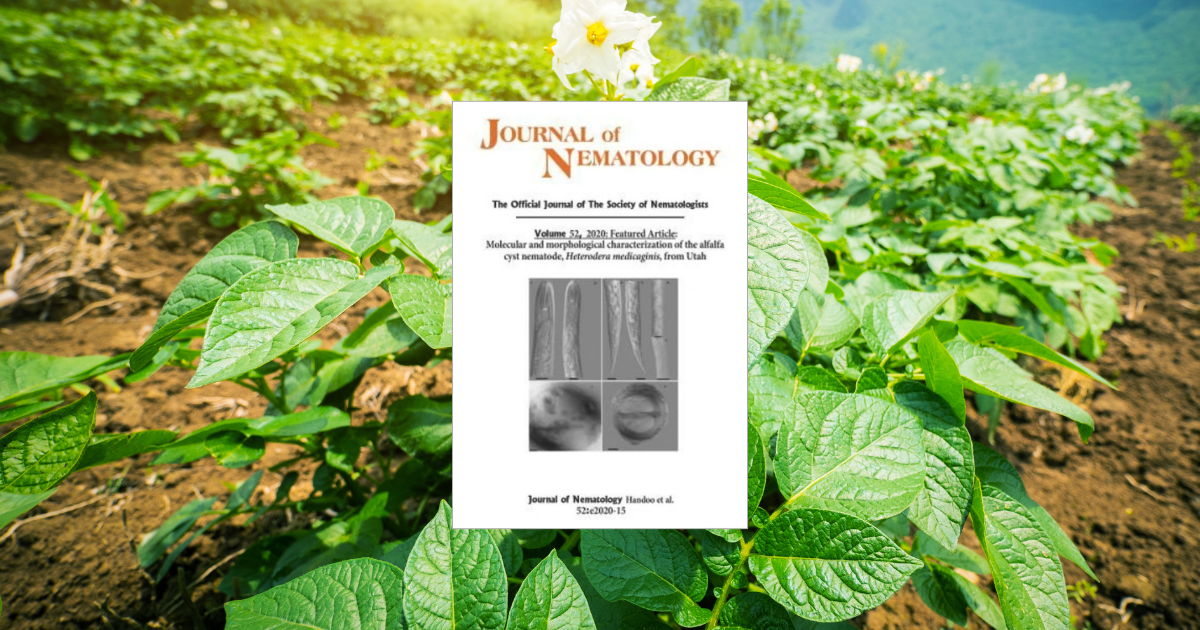
“Development of a Loop-Mediated Isothermal Amplification Assay for Rapid and Sensitive Detection of Globodera ellingtonae,” now available in the Journal of Nematology, describes the first-ever rapid molecular diagnostic test for the potato cyst nematode, Globodera ellingtonae.
G. ellingtonae was first described in 2008 after detection in Oregon and Idaho. Unlike the two federally quarantined potato cyst nematodes, G. pallida (pale cyst nematode) and G. rostochiensis (golden nematode), G. ellingtonae has not been shown to cause severe economic losses in potato production.
While G. ellingtonae is not subject to federal quarantine, it has presented a challenge for diagnosticians, regulators, and researchers where it occurs: it looks nearly identical to pale cyst nematode and golden cyst nematode under a microscope.
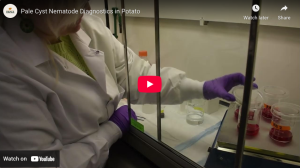
Traditional identification requires specialized expertise and considerable time to examine the physical characteristics of cysts, eggs, and second-stage juveniles. The new diagnostic tool is a LAMP assay — Loop-Mediated Isothermal Amplification — a fast, accurate molecular test that could tell these species apart with certainty.
LAMP Assay Advantages
The LAMP assay is accessible to diagnostic laboratories and survey programs for regulatory and field use:
- Amplifies G. ellingtonae DNA precisely — with no cross-reactivity against G. pallida or G. rostochiensis even in mixed samples.
- No specialized imaging equipment required — requires only a simple heating block or water bath, not a thermocycler or real-time PCR platform.
- Visual results — a positive result produces a visible color change from orange to green.
- Complete results in 30 minutes under optimized conditions — compared to hours or days for traditional morphological identification.
- Reliably detects G. ellingtonae DNA at low concentrations — more sensitive than conventional PCR.
This work builds on the LAMP assay previously developed by PAPAS for G. pallida detection, and is the first LAMP assay validated against all three Globodera species in one framework.
Improving Potato Nematode Diagnostics and Decision Support
Sound management decisions depend on accurate identification of the nematode species present in a field. This LAMP assay work directly advances the PAPAS project objective, “Deploy improved diagnostics and decision support for nematode management,” by giving diagnostic laboratories and regulatory programs a tool that can quickly distinguish G. ellingtonae from regulated Globodera species.
“Development of a Loop-Mediated Isothermal Amplification Assay for Rapid and Sensitive Detection of Globodera ellingtonae” is published open access in the Journal of Nematology, Volume 58, Issue 1, 2026.
For more PAPAS research updates and nematode management resources, join our mailing list.