Selecting for Success: Potato Harvest is like a Box of Chocolates
A potato breeder never truly knows what they’ll get from a cross until the first harvest in the field.

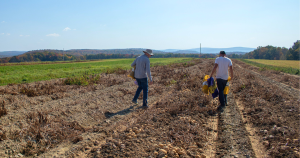
A potato breeder never truly knows what they’ll get from a cross until the first harvest in the field.
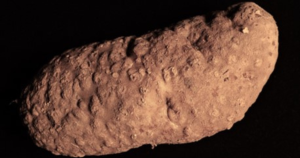
Found in the western US, Columbia root-knot nematode (Meloidogyne chitwoodi) infects potato roots and tubers, causing blemishes and defects that reduce quality.
Learn more about one of the objectives of the PAPAS project: to develop cultivars resistant to several nematodes that attack potatoes.
Read our newsletter to learn more about the PAPAS project goals, research team, and industry impact of potato nematodes.
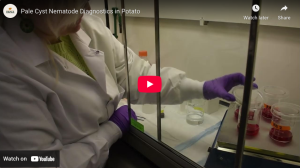
Research to help determine the impact of pale cyst nematode population densities on different potato varieties.
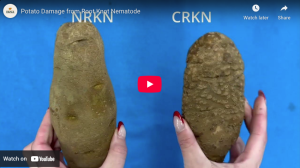
Damage to potatoes caused by northern root-knot and Columbia root-knot nematodes.
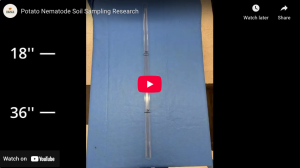
Sampling depth is an important factor in the likelihood of detecting nematodes through soil sampling. However, while the horizontal movement of nematodes in soil has been widely studied, research on their vertical movement is lacking.
Searle Farms owner-grower Bryan Searle, (Shelley, Idaho) recounts the challenges of pale cyst nematode detection in 2006.
The 2017 Snake River Pest Management Tour provides an update on work to control and eradicate the pale cyst nematode in Idaho.
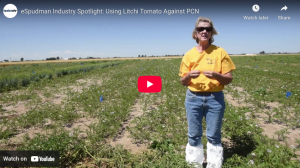
Researchers see promising results studying the efficacy of Solanum sisymbriifolium (litichi tomato or sticky nightshade) as a non-host trap crop to help eliminate pale cyst nematode in eastern Idaho.